How to Choose Local UK Honey at a Farmers' Market: An Explainer
A farmers' market honey stall is one of the nicest things about a Saturday morning. Rows of jars, a bowl of wooden tasters, a beekeeper happy to talk for twenty minutes about the bramble flow. It is also one of the easiest places to buy something that is not quite what you assumed.
Honey keeps for years, travels well and looks broadly the same whether it came from three hives at the end of the lane or from a bulk container blended somewhere else entirely. What you have at a market that you do not have in a supermarket is the person who filled the jar, standing in front of you. Use them.
Where the hives are matters more than the label design
Honey is local because of where the bees flew, not where the jar was filled. Bees generally forage within a couple of miles of the hive, so a jar from hives on the edge of your town really is a product of your area's gardens, hedgerows and field margins. A jar from hives two counties away, decanted in a unit on your local industrial estate, is not.
So the first question is not about the honey at all. It is about the apiary. Ask where the hives actually stand — a village, a farm name, a postcode district. If the answer is vague while the branding is heavy on county names and sketched church towers, that is worth noticing. Some stallholders are beekeepers; some are honey traders who buy in drums and jar under a nice local name. Both may be perfectly honest, but only one is selling you something from round the corner.
Reading a honey label properly
Labels on honey sold in the UK are required to state the country of origin, and that line is the quickest reality check on the jar. "Produce of England", "Product of Wales" or simply "UK honey" tells you where it came from. "A blend of EU and non-EU honeys" tells you something too: it is legal, but it means the contents have travelled and nobody knows what the bees were working. That is not a local jar, whatever the banner above the stall says.
Beyond the origin statement, look for:
- The beekeeper's name — not just a brand name, or a farm that also sells eggs, jam and candles.
- An address, or at least a village you could in principle go and visit.
- A harvest date, or a best-before that suggests it is recent. Honey holds up well, but it slowly fades in aroma; a jar from several seasons back belongs in baking, not on your toast.
- A floral source, if one is claimed — heather, borage, lime. In most of the UK the honest answer is "mixed", which is fine.
Two words to treat with caution: raw and unfiltered. Neither has a settled legal definition here, so they describe a process rather than guarantee anything you can check. That does not make the honey bad — plenty of small beekeepers genuinely do the minimum to their crop — but the useful questions are the ones you ask out loud: has it been heated, and how finely has it been strained?
What to ask the person who made it
This is the part most people skip. A few straightforward questions will tell you more than any label, and most beekeepers are delighted to answer them.
- Are these your own bees? If not, whose are they?
- Where are the hives? Push gently for a place, not a region.
- Which season is this from? Spring, summer and late-summer honey taste and behave very differently.
- What were the bees working? Bramble, lime, clover, heather, oilseed rape, garden flowers.
- Has it been heated or finely filtered? Both are common; both affect aroma and how quickly the jar sets.
- Is it one crop or blended across the year? Blending is normal for a small producer with a modest harvest — you should simply know about it.
If the answers are confident and specific, buy a jar. If they are breezy and general, buy one anyway if you like the taste, but do not pay a premium for a story.
Season and forage change everything
Two jars from the same hives, six weeks apart, can look and taste like different products. Spring honey in much of the UK often carries a lot of oilseed rape: pale, mild, and setting hard and fast, sometimes within weeks of jarring. Summer honey — bramble, clover, lime — is usually darker, more aromatic and stays runny for longer. Heather honey from late-summer moorland is a law unto itself: thick, thixotropic, so it gels rather than pours, with a strong, slightly bitter edge that people either love or do not.
Crystallisation is not a fault and it is not a sign of sugar syrup. It is simply what honey does. Set honey is honey that has crystallised in a controlled way, often deliberately, by stirring in a little fine-grained seed honey. If you prefer it runny, stand the jar in a bowl of warm water; do not microwave it, which is a quick way to cook out the aromatics.
Taste before you pay
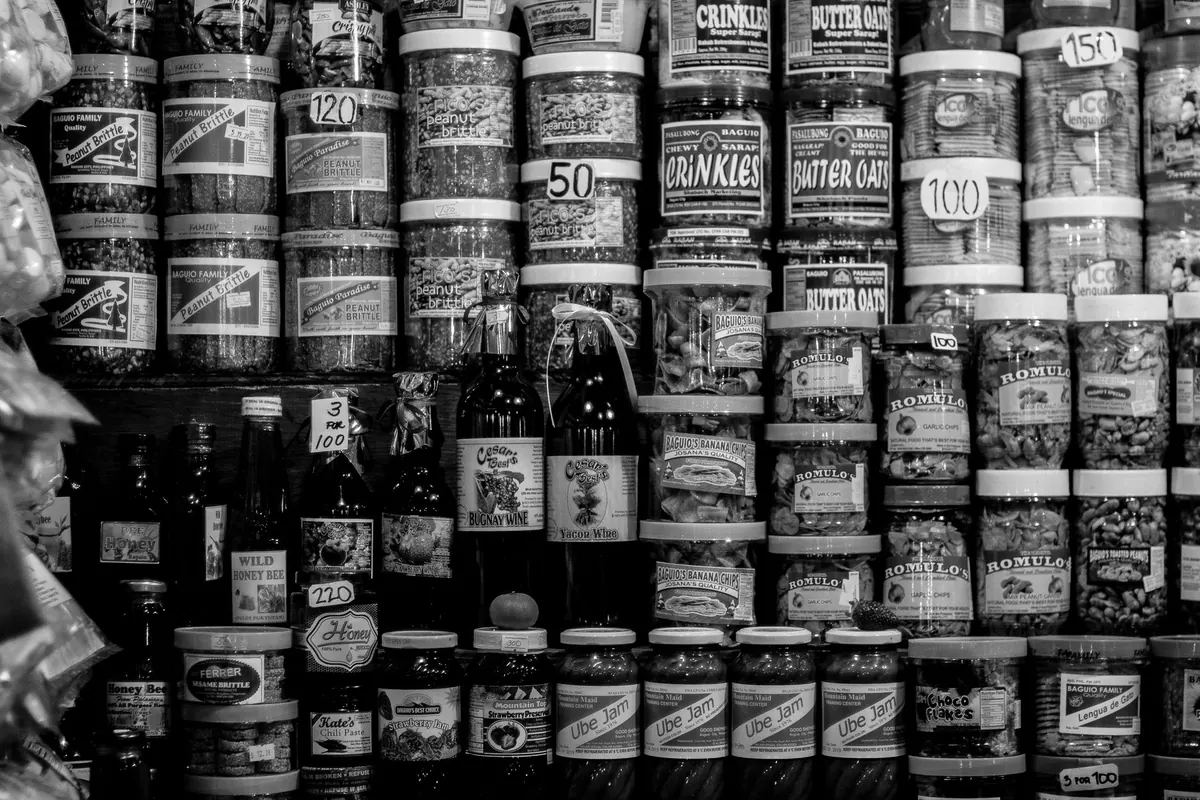
Most market stalls will let you taste, and that little wooden spoon is the best piece of equipment you own. Take a small amount, let it sit on your tongue rather than swallowing straight away, and pay attention to three things: the smell (floral, fruity, grassy, caramel, faintly smoky), the taste, and the finish — does it linger, or vanish?
If two jars are fighting for your attention, taste them side by side. It is far easier to judge a honey against another honey than in isolation. And if you are buying for a specific job — drizzling over yoghurt, baking, sweetening tea — say so. A robust dark honey will hold its own in a strong cup of tea where a delicate lime honey would simply disappear.
A short market checklist
Before you hand over your money, run through this:
- The hives are local, and the seller can name the place.
- The country of origin is stated, and it is the UK.
- The beekeeper's name is on the jar.
- The harvest is recent, and you know which season it came from.
- You have tasted it, and you actually like it.
Buy one jar, write the year on the lid in marker, and go back to the same stall next season. A relationship with a local beekeeper is worth more than any labelling scheme: you learn what a good year tastes like, what a poor one tastes like, and you will get first refusal on the heather.
One last thing. Local honey is often recommended for hay fever, on the theory that traces of local pollen build tolerance. The evidence for this is limited and the amounts involved are small, so if your symptoms are bothering you, speak to a pharmacist or your GP rather than relying on a teaspoon of honey. Enjoy it for what it plainly is: a genuinely local, genuinely seasonal food, and one of the very few you can trace back to a particular field.
Photo: Nothing Ahead / Pexels
Raised Bed vs Container Gardening: Which Is Better for UK Patios?
Raised beds and containers both work on a UK patio, but they differ in cost, watering, yield and space....
Plants for a Pollinator-Friendly Balcony in Shade: A Comparison
A practical comparison of shade-tolerant pollinator plants for UK balconies, covering pot sizes, watering...
About Us